CPH:DOX 2026 – Opening Speech
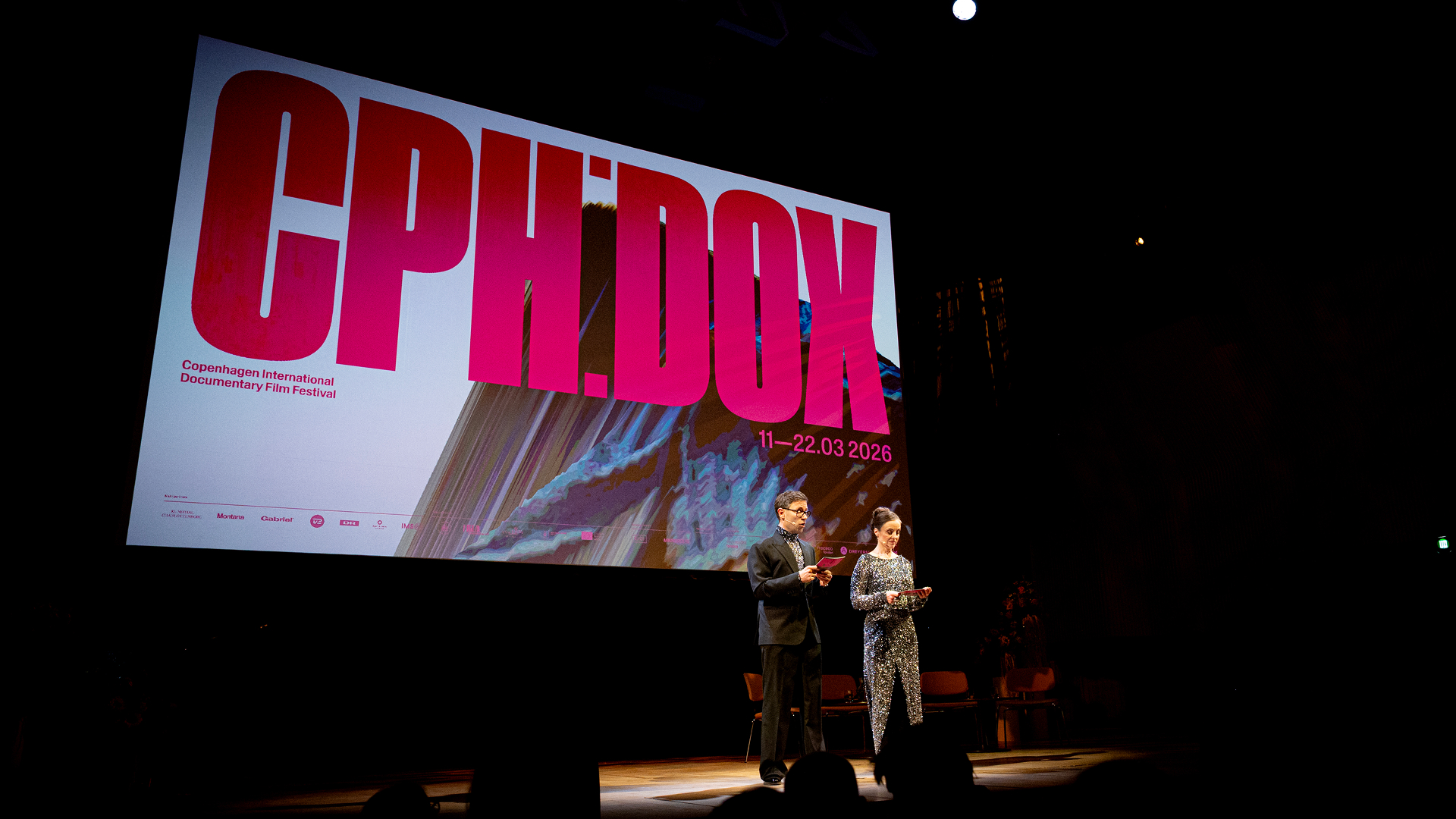
By Katrine Kiilgaard, Managing director & Niklas Engstrøm, Artistic director (PHOTO: the directors on stage).
This year’s opening film, MARIINKA, is a powerful example of what documentary cinema can do at its very best: it takes us beyond the headlines and allows us to encounter the people who live under the conditions those headlines represent. It can make us feel the world and grasp the immense complexity of reality. A reality that is almost always wilder and stranger than the simplifications and binary oppositions dominating the increasingly algorithmic media landscape – with war perhaps being the ultimate example of such simplification: us or them.
When a documentary like MARIINKA is able to do this, it is first and foremost because it takes its time.
Pieter-Jan De Pue began this film shortly after the war in eastern Ukraine broke out in 2014. He has spent nine years on this story. Nine years following the lives of the people who lived in the town of Mariinka, until it was completely destroyed during Russia’s full-scale invasion in 2022. Nine years finding and building relationships with the people at the heart of the film.
When you allow yourself that kind of time, you also give yourself the opportunity to create a sense of presence in another world. That time, and that presence, are among the things that make documentary film such a singular art form.
That does not mean documentary films cannot also be many other things. Quite the opposite. Since the festival began in 2003, we have worked to expand the space of possibility for what documentary cinema is – and what it can be. Again this year, you will find all kinds of films at CPH:DOX: personal confession, poetic imagery, journalistic sharpness, activist fire, essayistic reflection, experimental playfulness, performative force, and quiet observation – a wealth of forms that together show the genre’s boundless strength and freedom.
Each film has its own gaze – more or less nuanced, driven by the filmmakers’ personal commitment, their anger, their curiosity, or their hope. Some zoom in on the most intimate; others zoom out to the global. Some seek answers; others go on asking questions without end.
But all of them have a place here. Together, they do not form a single unison song, but a polyphonic chorus – at once harmonious and discordant, provocative and conciliatory. Voices which, taken together, make the case we as a festival want to put forward: that reality is infinitely complex. The truth may be difficult to grasp, but we become wiser by listening to the many different ways of approaching it.
That is why we devote so much energy to presenting the films in context. That is why we organise hundreds of debates, talks, and events in which the films are contextualised, analysed, discussed, and challenged.
For us at CPH:DOX, this is about bringing together people with very different perceptions of reality and giving them the opportunity – hopefully – to become just a little wiser about one another.
It is about cultivating dialogue, even when it is difficult.
About creating a space in which we can have conversations about all that we share, but also about all that divides us. And all that cannot simply be brushed aside.
It is through those conversations that we, as a festival, can truly help documentary cinema attain social significance and become a vital contribution to our democracy. Without silencing any voice.
This will be especially important over the next two weeks, as this year’s festival runs in parallel with the election campaign leading up to the general election on 24 March. Honestly, it is hard to imagine a better prelude to casting your vote than going to the cinema, becoming wiser about the world, and allowing yourself to be challenged by perspectives other than your own.
Why do we spend so much time speaking about this? Is it not simply self-evident that pluralism should define a festival like CPH:DOX?
The answer is no.
Increasingly, cultural institutions around the world are being asked to exclude certain voices, declare their loyalties, and fall into line – so that polyphony gives way to uniformity. This pressure can come from many directions, but it is, of course, most troubling when it comes from the political sphere.
We see this, for example, in Berlin, where one of the world’s largest film festivals has, in recent weeks, come close to unravelling. Following the awards ceremony in February, during which several winners used the stage to criticise Israel’s actions in Gaza and Germany’s role in them, a wave of political backlash was set in motion.
The German government called an emergency meeting, which has now resulted in a series of clear recommendations that the festival establish a political advisory board to guide it on so-called “politically sensitive” issues. It is hard not to see this as an attempt to undermine the public policy principle of arm’s-length – and that is a deeply dangerous path to go down.
At the same time, a brand-new survey from Dansk Kulturliv (the Danish cultural sector’s joint advocacy alliance representing over 1,100 institutions and organisations) shows that Danish cultural institutions, too, are increasingly facing expectations as to which voices should be given space – and that in some cases this is even leading to self-censorship.
When considerations like these begin to creep in, there is every reason to remain vigilant.
The arm’s-length principle is not just a detail. It is the precondition for art to remain free, critical, and polyphonic – and for cultural institutions to remain open and curious in relation to the world around them. That is why it is absolutely crucial that we hold fast to it – locally, nationally, and across the political spectrum. Because without it, culture risks losing precisely the space in which difficult conversations can take place. And the reason we dare to invite the Minister of Culture into the room tonight is that – however many kind words may be exchanged between him and us – neither he nor any other politician interferes in which films are shown at this festival. Let it stay that way.
By now, it should be clear that CPH:DOX functions as a prism: a place where the light of hundreds of filmmakers is gathered and refracted into a rich spectrum of perspectives on the world.
Each year, we shift that prism slightly, and in 2026 we have turned it towards a world in violent transformation – with a double focus:
Outwardly, we look at the reshaping of the international world order and what it means for human rights.
Inwardly, we look at the reshaping of the inner world order and what it means for the human brain.
On the one hand, we see an international community where might increasingly trumps right. In which the strong do what they can, and the weak suffer what they must, as the Greek historian Thucydides put it two and a half thousand years ago, and as, tragically, it sounds once again with chilling relevance.
What happens to human rights, to international law, and to the principles meant to protect us against the arbitrariness of power when the world as we know it begins to fracture? That is the question we ask, together with Kunsthal Charlottenborg, Human Rights Watch, IMS, and the Frececo and Dreyers foundations, in our major thematic programme RIGHT HERE, RIGHT NOW.
On the other hand, we turn our gaze inward. For our inner world order, too, is shifting. With support from the Lundbeck Foundation, we are therefore launching an entirely new research-based film programme, BRAINWAVES, focusing on the human brain from a biological, cultural, and societal perspective – at precisely the moment when algorithms, artificial intelligence, and neurotechnology are challenging our understanding of what it means to think, to feel, and to be human.
One of the researchers visiting the festival in this context is the neurologist Nicholas Wright. He has not only conducted research into human intelligence and artificial intelligence — he has also advised the Pentagon, because his primary field is the relationship between the human brain and that all-too-human phenomenon: war.
At this year’s festival, we ask the same question that Wright poses in his latest book, Warhead:
How does the brain behave in war? And what does war do to the brain?
And so we return to tonight’s film.
For MARIINKA is, above all, a film about what war does to people. To families. To relationships. To lives that cross front lines and are never the same again.
A film like this could not exist without a filmmaker with a truly exceptional eye — and Pieter-Jan De Pue has precisely that. But nor could it have come into being without collaboration across Europe: institutions and partners who have made it possible for the artist’s talent and patience to unfold over nearly a decade. These are the kinds of films — and the kinds of collaborations — the world needs. And that is why we have supported the project all the way: from its early stages, when it was first pitched at our financing forum, to tonight, when it will, for the very first time, meet the eyes of an audience: yours.
After the film, Danmarks Radio’s Ukraine correspondent, Matilde Kimer, will join us on stage to lead a conversation with the director himself, as well as — importantly — one of the film’s main protagonists, Natasha Borodynia, and the film’s Ukrainian line producer, Anna Konik. So please do stay in your seats when the credits begin to roll in an hour and a half.
Enjoy the world premiere of MARIINKA.
