Bent Noerby Bonde Opens Baltic Sea Docs
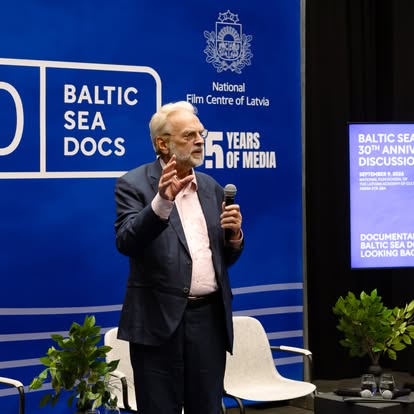
Good evening, friends, colleagues, and guardians of the documentary tradition.
It is wonderful again to see the many friends and colleagues I have known for almost 30 years, but it is even better to see all of you who are decades younger and take part in the Forum to shape the future for yourself and for all of us.
Thirty years ago—on a June morning in 1997 twenty-five documentary projects were presented to a panel of commissioning editors in the old Kino Gudhjem on the island of Bornholm.
That first Baltic Sea Forum for Documentaries was more than a pitching session. It was an act of faith. Faith in the power of co-production to build understanding across borders that had only recently begun to open. Faith in stories from the East that deserved to be seen in the West. Faith in a genre—documentary—that was, at the time, struggling to find its place in a rapidly changing media landscape.
Today, as we gather in Riga for the 30th anniversary of Baltic Sea Docs, we celebrate not just an event. We celebrate a movement. A movement that has helped shape the very concept of the Baltic documentary film producer—a profession that did not exist under the Soviet regime.
What were the visions
The founding vision of this Forum was simple yet profound. As the early documentation states: “If you wish to access funding in another country than your own, you need to have an alliance with a co-producing company in that country.”
When we started the main investors were national public service media and film institutes that planned to screen the final productions.
This principle—born from the practical realities of film financing—became something far greater. It became a method of peacebuilding through culture.
Think about what that means. Co-production is not just about money. It is about trust. It is about relationships. It is about sitting in a room with people from different countries, different languages, different histories—and finding common ground in a story that matters.
Over three decades, an average of 25% of the projects that participated in this Forum have received international funding or become international co-productions. But the numbers tell only part of the story.
What truly matters is the collaboration across borders that these meetings have created. Developing projects with the help of TV commissioning editors who love to take part in a creative process. Building networks that outlast the Forum itself. Creating alliances that turn competitors into collaborators.
Look around this room. Some of you have been here for twenty editions. Some of you are here for the first time. But all of you are part of the same story—a story that began on Bornholm in 1997 and has travelled through Dubrovnik, Tallinn, Vilnius, and, since 2006, found its permanent home here in Riga.
The Founders and Guardian Angels
No anniversary celebration would be complete without honouring those who made this journey possible. Let me begin with the names that must be spoken tonight.
Tue Steen Müller. Tue’s voice has guided this Forum from its first morning in Gudhjem to this 30th edition—moderating, mentoring, and never losing his addiction to documentaries from the East of Europe. As he wrote in 2016, celebrating 20 years: “Thanks for letting me into a world of documentaries that I have become totally addicted to.” Tue, we thank you for that addiction—and for sharing it with all of us.
Sonja Vesterholt who could not be present, joined me in 1989 on Bornholm to document the complete regional transformation toward democracy and European cooperation and laid the groundwork for what would become the Balticum Film & TV Festival and, ultimately, this Forum. The Baltic Sea was no longer a divide but a new possibility of cooperation.
On that first morning in 1997, it was Sonja who opened the Forum alongside Alexander Krivonos from St. Petersburg with Searching of the Russian Avant-Garde Artists, setting the tone as bold, creative, and unafraid to tell difficult stories.
Simon Drewsen Holmberg. – One of the founders of Baltic Sea Docs, as my deputy at the Baltic Media Centre on Bornholm. Simon was a visionary who saw that unknown Baltic stories were worth breaking out into the world.
Lelda Ozola wrote in her tribute earlier this year: “Simon has undoubtedly left his footprint in the Baltic documentary scene, and it cannot be erased. And we are sure that he’ll continue to guide us as a guardian angel from the silver lined heaven.”
Simon’s passing is a profound loss. But his legacy lives on in every project that finds its way through this Forum to international audiences.
The Latvian Success Story—Lelda and Ilze
And then there are the two names that keep on coming back, as Tue Steen Müller wrote: Lelda Ozola and Ilze Galite Holmberg—the guardian angels of the Forum.
Lelda Ozola produced the first three editions of the Forum on Bornholm (1997– 1999). Her journey from the Soviet republic of Latvia to becoming a cornerstone of the National Film Centre of Latvia exemplifies the transformative power of this Forum.
As Lelda herself recalled, she used her experience from Bornholm to continue growing together with the Latvian film industry. Today, Lelda remains a vital force in Baltic documentary culture.
Ilze Galite Holmberg produced the fourth edition of the Forum and, as director of the National Film Centre of Latvia, initiated the parallel film programme that has become a Forum tradition.
Ilze’s logistical and technical skills carried the Forum through challenging moments— including the memorable 2001 edition as part of the SEE Docs of Dubrovnik that was a sister festival to Balticum Film & TV Festival.
Ilze’s warmth and professionalism, alongside Zanda Dudina’s, became the fundament of the Forum, when it found its permanent home in Riga in 2006.
Together, Lelda and Ilze represent the Latvian success story that we celebrate tonight: the transformation of the Baltic Sea Forum from Bornholm into a solid international event that has become the most important documentary event in the Baltic countries—highly respected for its professionality and loved for its friendly and inclusive atmosphere.
The Balticum Model—Economic Sustainability Through Culture
We must also stress the Latvian success with making the Forum into a solid international event for the economy of documentaries.
What began in 1990 as a festival founded by TV2 Bornholm evolved into a model of sustainable cultural cooperation. The setting up of the Forum created a unique ecosystem where artistic excellence met economic viability—where festival fees, distribution deals, and co-production agreements could multiply a filmmaker’s income.
As the role of commissioning editors’ financial importance decreased over the decades, sales agents and distributors grew enormously in influence—becoming go- betweens, who could secure festival money, VideoOnDemand deals, and non- theatrical distribution.
The Balticum model anticipated this shift. It created a space where filmmakers could meet not just broadcasters, but the full spectrum of decision-makers who determine whether a documentary finds its audience, It is about building a sustainable ecosystem for documentary film in a region that has known censorship, conflict, and the struggle for independence.
Why Documentaries Matter
Why does this matter? Why was it worth spending thirty years with this Forum? Because documentaries ask not just what is happening, but how does it happen—
and perhaps also why does it happen that way.
In a region that has known conflict, censorship, and the struggle for independence, documentaries have been a tool for telling the truth between the lines—creatively, visually, courageously. Today, as the Baltic Sea countries face renewed tensions— Russia’s war in Ukraine continues, hybrid threats target critical infrastructure, and NATO responds with enhanced security measures—the work of documentary filmmakers carries even greater weight.
From Ivars Seleckis’s Crossroad Street to Ukrainian filmmakers documenting their reality with extraordinary courage at this Forum, these projects have not only recorded history—they have helped shape it. In an age of electronic warfare and contested narratives, documentary film remains one of the few spaces where we can still navigate by True North.
The Next Thirty Years
Let us continue this work—of co-production, of collaboration, of building understanding through the power of documentary film.
Photo A. Zeltina.
Bent 09.09.2026
